Be taught Complete On-Page search engine optimisation for Newbies Full Tutorial in Hindi
Warning: Undefined variable $post_id in /home/webpages/lima-city/booktips/wordpress_de-2022-03-17-33f52d/wp-content/themes/fast-press/single.php on line 26
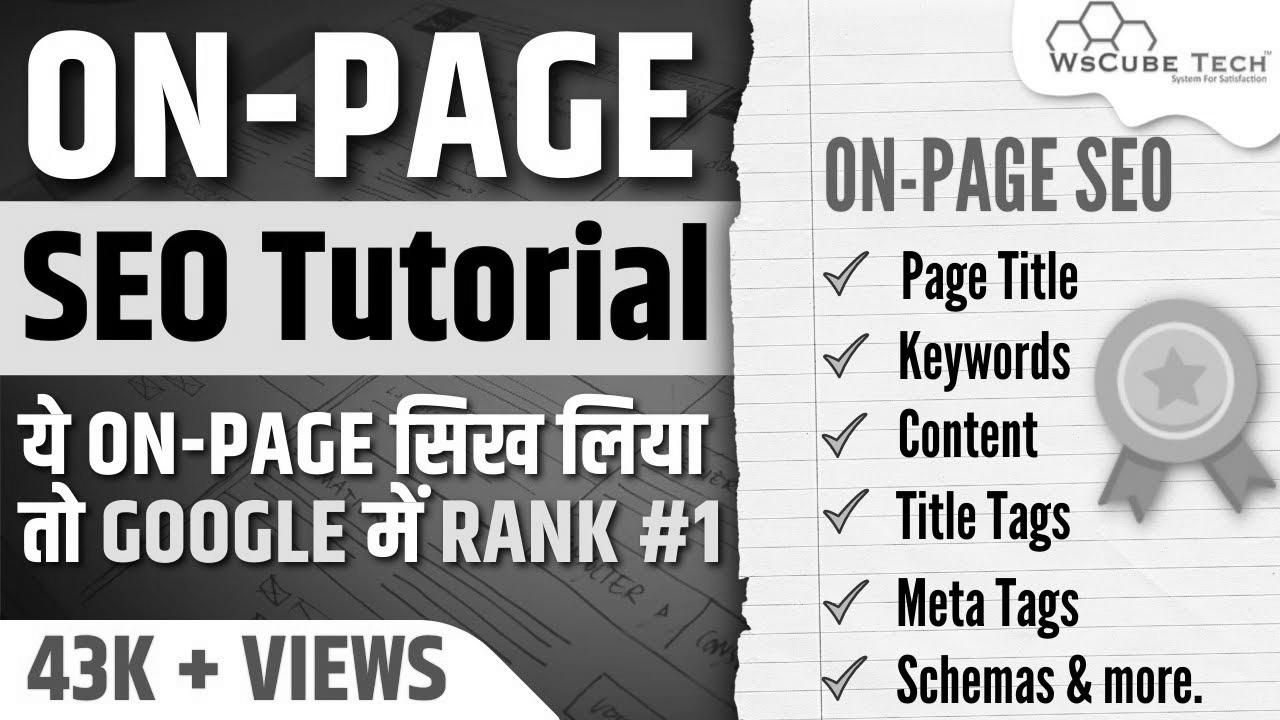
Make Seo , Study Complete On-Web page search engine optimization for Rookies Full Tutorial in Hindi , , AQ5-L345SGI , https://www.youtube.com/watch?v=AQ5-L345SGI , https://i.ytimg.com/vi/AQ5-L345SGI/hqdefault.jpg , 87754 , 5.00 , To optimize the rating of a website on Google, the on-page search engine marketing plays the most important position. But what's on web page search engine optimization and ... , 1618752600 , 2021-04-18 15:30:00 , 01:52:42 , UC0T6MVd3wQDB5ICAe45OxaQ , WsCube Tech , 3075 , , [vid_tags] , https://www.youtubepp.com/watch?v=AQ5-L345SGI , [ad_2] , [ad_1] , https://www.youtube.com/watch?v=AQ5-L345SGI, #Be taught #Complete #OnPage #search engine optimization #Newcomers #Full #Tutorial #Hindi [publish_date]
#Study #Full #OnPage #SEO #Rookies #Full #Tutorial #Hindi
To optimize the rating of a web site on Google, the on-page search engine optimisation plays the most important role. However what is on page website positioning and ...
Quelle: [source_domain]
- Mehr zu learn Encyclopaedism is the physical process of acquiring new reason, noesis, behaviors, skill, values, attitudes, and preferences.[1] The quality to learn is controlled by homo, animals, and some machinery; there is also inform for some sort of education in definite plants.[2] Some encyclopaedism is proximate, induced by a separate event (e.g. being injured by a hot stove), but much skill and noesis lay in from repeated experiences.[3] The changes evoked by encyclopaedism often last a time period, and it is hard to place nonheritable stuff that seems to be "lost" from that which cannot be retrieved.[4] Human education starts at birth (it might even start before[5] in terms of an embryo's need for both interaction with, and exemption within its state of affairs within the womb.[6]) and continues until death as a consequence of current interactions betwixt folk and their surroundings. The existence and processes active in encyclopaedism are affected in many established fields (including educational psychological science, psychophysiology, experimental psychology, cognitive sciences, and pedagogy), too as nascent comic of cognition (e.g. with a common interest in the topic of encyclopedism from device events such as incidents/accidents,[7] or in collaborative education wellbeing systems[8]). Explore in such w. C. Fields has led to the identification of various sorts of encyclopaedism. For instance, education may occur as a consequence of physiological condition, or conditioning, operant conditioning or as a effect of more intricate activities such as play, seen only in comparatively rational animals.[9][10] Encyclopedism may occur consciously or without cognizant cognisance. Learning that an aversive event can't be avoided or free may event in a state named conditioned helplessness.[11] There is testify for human behavioural education prenatally, in which dependence has been discovered as early as 32 weeks into biological time, indicating that the cardinal troubled organization is insufficiently formed and primed for encyclopaedism and remembering to occur very early in development.[12] Play has been approached by several theorists as a form of learning. Children research with the world, learn the rules, and learn to act through play. Lev Vygotsky agrees that play is crucial for children's growth, since they make substance of their situation through playing educational games. For Vygotsky, nevertheless, play is the first form of education terminology and human activity, and the stage where a child started to read rules and symbols.[13] This has led to a view that encyclopedism in organisms is e'er associated to semiosis,[14] and often connected with nonrepresentational systems/activity.
- Mehr zu SEO Mitte der 1990er Jahre fingen die anstehenden Suchmaschinen im Internet an, das frühe Web zu systematisieren. Die Seitenbesitzer erkannten rasch den Wert einer lieblings Positionierung in Suchergebnissen und recht bald entstanden Unternehmen, die sich auf die Optimierung ausgebildeten. In den Anfängen bis zu diesem Zeitpunkt die Aufnahme oft zu der Transfer der URL der jeweiligen Seite in puncto diversen Suchmaschinen im Netz. Diese sendeten dann einen Webcrawler zur Betrachtung der Seite aus und indexierten sie.[1] Der Webcrawler lud die Website auf den Server der Suchmaschine, wo ein zweites Programm, der allgemein so benannte Indexer, Informationen herauslas und katalogisierte (genannte Ansprüche, Links zu anderweitigen Seiten). Die zeitigen Versionen der Suchalgorithmen basierten auf Angaben, die mit den Webmaster selbst vorliegen sind, wie Meta-Elemente, oder durch Indexdateien in Internet Suchmaschinen wie ALIWEB. Meta-Elemente geben einen Gesamtüberblick mit Essenz einer Seite, jedoch setzte sich bald raus, dass die Benutzung der Tipps nicht zuverlässig war, da die Wahl der angewendeten Schlagworte dank dem Webmaster eine ungenaue Darstellung des Seiteninhalts spiegeln hat. Ungenaue und unvollständige Daten in den Meta-Elementen konnten so irrelevante Internetseiten bei spezifischen Brauchen listen.[2] Auch versuchten Seitenersteller verschiedenartige Merkmale im Laufe des HTML-Codes einer Seite so zu beeinflussen, dass die Seite passender in Suchergebnissen gelistet wird.[3] Da die neuzeitlichen Suchmaschinen im WWW sehr auf Aspekte angewiesen waren, die allein in den Fingern der Webmaster lagen, waren sie auch sehr instabil für Falscher Gebrauch und Manipulationen in der Positionierung. Um bessere und relevantere Resultate in Ergebnissen zu erhalten, mussten sich die Anbieter der Suchmaschinen an diese Faktoren einstellen. Weil der Gewinn einer Suchmaschine davon abhängig ist, relevante Suchergebnisse zu den inszenierten Keywords anzuzeigen, vermochten untaugliche Resultate zur Folge haben, dass sich die Nutzer nach ähnlichen Möglichkeiten bei der Suche im Web umgucken. Die Lösung der Suchmaschinen im Internet lagerbestand in komplexeren Algorithmen für das Rangordnung, die Gesichtspunkte beinhalteten, die von Webmastern nicht oder nur schwer beherrschbar waren. Larry Page und Sergey Brin entworfenen mit „Backrub“ – dem Vorläufer von Yahoo – eine Recherche, die auf einem mathematischen Suchalgorithmus basierte, der mit Hilfe der Verlinkungsstruktur Websites gewichtete und dies in den Rankingalgorithmus einfließen ließ. Auch andere Suchmaschinen relevant in Mitten der Folgezeit die Verlinkungsstruktur bspw. in Form der Linkpopularität in ihre Algorithmen mit ein. Yahoo
😎Hey, thanks for watching! We’d love to know your thoughts/doubts here in comments.
👉Don’t forget to SUBSCRIBE our channel for more such videos & valuable content: https://bit.ly/YouTube-WsCubeTech
For professional certification courses, visit: https://bit.ly/certification-courses
I have a question
Agr hamri website 3 different places pr rank krwani ho to 3 alg alg pages bany chahiay ya ak hi rkhba chahiay
Like mujy ak website ko optimize krna hai jo 3 cities man service provide krti hai to mery keywords 3 hon gy or tino hi primary homg apny city ky hisab sy to tb kia krna chaiay
Example keywords
Cleaning services in Lahore
Cleaning services in Karachi
Cleaning services in Delhi
Thank you for the information
I want to know
Is every product on my affiliate website requires seo separately?
This is really
Its such a informative video.
Amazing
You did an excellent work
Great👍
Nice
Nice video
I'm happy to be part of this video 📹.
very very nice
Thanks video
It's a very informational video
It's a very informational video
Harika
Nice
Anlatiminiz çok güzel hocam çok beğendim 👏
Nice
Very good video and great information
Nice
thanks so much teacher
thanks so much teacher
Primary or secondary keywords ka detail mey Bata dey
informative
How to write ALT Text of logo of your brand? or mutiple logos listed on your website?
🤗
😍
😂
😁
😍
🙌
🙌